
In the shadowed cathedral of the redwoods, where fog drifts like ancestral breath through the columns of ancient coast sequoia (Sequoia sempervirens), the forest floor is dim and damp, shaped by millennia of coastal precipitation, poor soil nutrients, and filtered light. Yet in this subdued, almost primeval stillness, tiger lilies blaze like fireflies made of flame and freckled gold.
These lilies are not intruders; they are California natives, evolved alongside the rhythms of the fog belt and the mosaic of coastal forest and riparian corridor. Their roots take hold in moist, well-drained soils, often near creeks or seeps fed by the marine layer and seasonal rains. With towering ferns and moss-laced alders nearby, tiger lilies make their quiet seasonal entrance—usually in early to mid-summer, when light briefly pierces deeper into the forest.
Geographically, Prairie Creek Redwoods State Park is positioned in the temperate rainforest zone of the Pacific Northwest’s southern edge. The convergence of coastal fog, steep topography, and year-round moisture creates an ecological niche perfect for this lily species. The lilies thrive along ecotones, where redwood stands meet open prairies, or where red alder (Alnus rubra) and bigleaf maple (Acer macrophyllum) allow more sunlight to reach the forest floor.
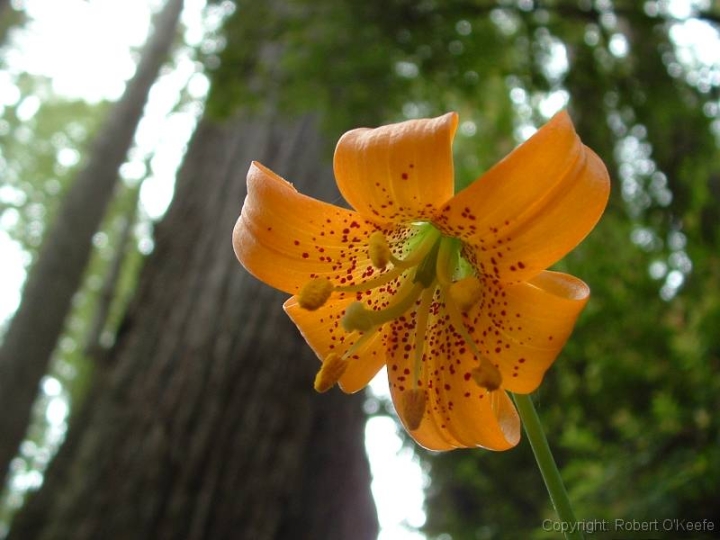
And so, in this lush realm where the tallest trees on Earth reach for the sky, the tiger lily does something more modest but no less spectacular: it blooms boldly in the understory, its orange petals curled backward like flames licking skyward, inviting pollinators—like swallowtail butterflies and hummingbirds—to take part in its quiet ritual of continuity.
It is a reminder that not all beauty in a redwood forest is towering and ancient—some of it is brief, low to the ground, and wildly alive with color.